Sep. 11, 2025
Introduction to the Infrared Touch Frame
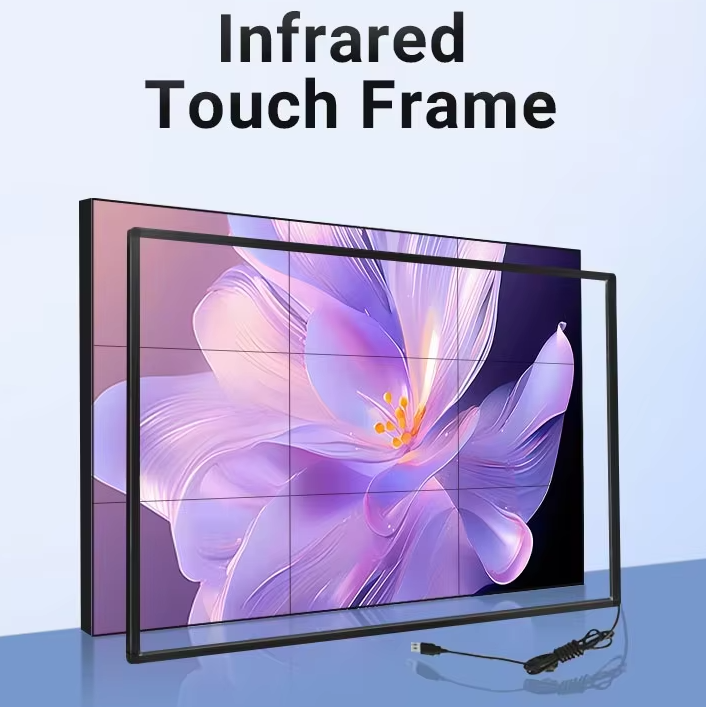
An infrared touch frame is a touch input device based on infrared technology. It doesn't emit light or display images itself. Instead, it acts as an external frame
that can be installed around a display screen (such as an LCD TV, LCD monitor, or projection screen), transforming a standard non-touch screen into a large,
interactive touchscreen.
I. Working Principle
The core principle is "optical barrier blocking."
1. Construction: The touch frame is densely packed with infrared emitting and receiving tubes along its X and Y directions (i.e., its four edges). These emitting
and receiving tubes correspond to one another, forming a horizontally and vertically interlaced infrared matrix grid.
2. Forming a Light Grid: When the touch frame is operating, these infrared tubes form a uniformly dense grid of invisible infrared rays, covering the entire screen
surface.
3. Detecting Touch: When an object (such as a finger or stylus) touches the screen, it blocks specific infrared beams intersecting in the X and Y directions at that
location.
4. Locating Coordinates: The controller quickly detects which infrared rays are blocked and calculates the location of the blocked infrared rays on the X and Y
axes to accurately determine the coordinates of the touch point. This coordinate information is then transmitted to a connected computer via USB or serial port.
5. Completing Interaction: Upon receiving the coordinate signal, the computer recognizes it as a mouse click or touch event and performs the corresponding
operation.
II. Key Features
· High Durability: The touchscreen surface is made of pure tempered glass, which is scratch-resistant, wear-resistant, and highly resistant to damage. Because
it relies on no coatings or films, it's scratch-resistant and has a long service life.
· High Transparency: The infrared touch frame does not affect the display quality of the screen itself, as it is located only on the periphery, with no layers in the
center, ensuring 100% original brightness and color.
· Supports Multiple Touch Objects: Any opaque object (fingers, gloves, pens, pointers, etc.) can trigger the touchscreen, providing wide adaptability.
· Easy Integration: Installation is relatively simple, eliminating the need to replace the entire screen; simply secure the frame around the monitor and connect
it to a computer.
· Cost-Effective: Especially for large-size touchscreens (e.g., 86 inches and above), infrared touch solutions are significantly less expensive than technologies
like capacitive screens.
III. Advantages and Disadvantages
Advantages:
1. Flexible Size: Easily supports ultra-large touch screens, ranging from a dozen inches to over a hundred inches.
2. Strong Anti-interference: Completely dustproof, waterproof, and anti-static, suitable for complex environments.
3. Easy Maintenance: A single point of failure (such as a broken infrared tube) may only affect touch in a local area, and repairs usually require replacing a single
tube, resulting in low cost.
Disadvantages:
1. Susceptible to strong light interference: Infrared components in ambient light (especially direct sunlight) can interfere with the infrared matrix's recognition,
causing false touches or malfunctions.
2. Frames: Early infrared frames had wide ("thick") frames, which affected their aesthetics. However, ultra-narrow and even "frameless" frames are now available.
3. Susceptible to obstruction: Dust, stains, or objects stuck on the frame's surface can block infrared light for extended periods, affecting touch functionality
and requiring constant cleaning.
4. Inability to detect pressure: The frame can only detect the location of the touch point, not the amount of pressure.
Applications of Infrared Touch Frames
Due to its cost, size, and durability advantages, infrared touch technology is widely used in various fields requiring human-computer interaction.
1. Education: This is the most classic application scenario for infrared touch frames.
· Interactive teaching all-in-one computers/electronic whiteboards: Almost all all-in-one teaching all-in-one computers in modern classrooms use infrared
touch technology. Teachers can use their fingers or a special stylus to write, annotate, erase, and manipulate courseware directly on the screen, greatly
enhancing the interactivity and fun of teaching.
2. Business and Conference Sector
· Conference Tablets/Smart Whiteboards: Products from brands like MAXHUB and Huawei IdeaHub often utilize infrared touch technology. They are used in
corporate conference rooms for remote collaboration, project discussions, brainstorming, and presentations, supporting simultaneous writing and operation
by multiple people.
· Information Kiosks/Self-Service Terminals: Widely used in places like banks, government offices, hospitals, shopping malls, museums, and libraries, they
provide self-service services such as map navigation, information search, and business processing.
· Digital Signage and Advertising Machines: Large outdoor or indoor advertising machines add touch functionality, allowing viewers to interactively search
for product information and participate in activities, enhancing advertising effectiveness.
3. Entertainment and Retail
· Interactive Game Consoles: Some large arcade games and interactive floor/wall projection games in children's parks often use infrared frames to capture
player movements.
· Interactive Retail Windows: Store windows equipped with infrared touch frames and transparent screens allow passersby to access product information
and receive coupons directly from the window, creating a high-tech experience.
4. Control and Command
· Command and Control Centers: In security monitoring, traffic dispatch, energy management, and other centers, large video walls equipped with infrared
touch functionality allow operators to directly click, schedule, and zoom in on surveillance footage, improving emergency response efficiency.
· Industrial Control: In some industrial environments, these systems can be used for production line control and equipment status monitoring.
Summary
Infrared touch frames are a mature, reliable, and highly cost-effective touch solution. They successfully transform any flat-panel display into an interactive tool.
Their core advantages lie in their large size, high durability, and low cost. While they may not be as accurate or resistant to light interference as high-end capacitive
screens, their wide range of applications has earned them an irreplaceable position in education, commerce, public services, and information services. With
technological advancements, products with narrower bezels, higher accuracy, and enhanced anti-interference capabilities are constantly emerging.
Previous Infrared conference all-in-one machine
Next Curved LCD modules
+0086 755 21042870
+0086 755 2822 5493
Shenzhen Company: 5/F, Building 211, Tairan Science Park, Tairan 4th Road, Shatou Street, Futian District, Shenzhen(518040), China.
Dongguan Factory: 2/F, Building D, Fulin Industrial Park, Weixi Road, Dalingshan Town, Dongguan City(523831), Guangdong,China
NAVIGATION
REQUEST A QUOTE